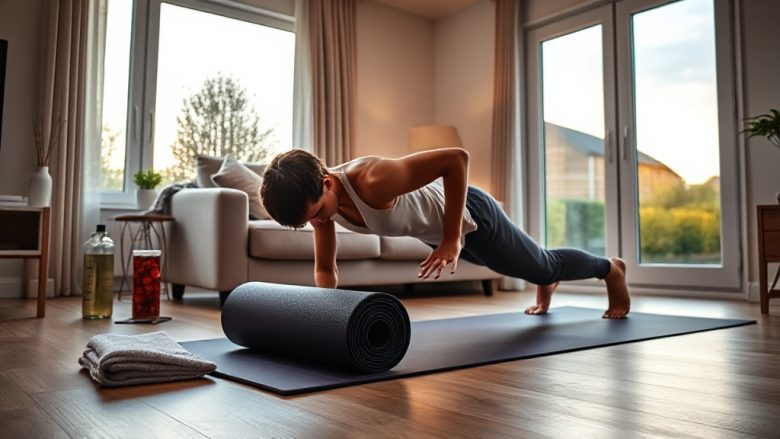
It’s Tuesday evening, it’s raining sideways against the window, and your living room is roughly the size of a decent parking space. The gym is a 25-minute bus ride away, the membership costs more than your broadband, and you’ve got maybe 40 minutes before dinner. So the question is simple: can you actually get genuinely strong using nothing but your own bodyweight, in a small flat, without buying a rack of equipment you’ll trip over?
Yes. This complete guide to bodyweight exercises in the UK is built around exactly that scenario — cramped floors, thin walls, unpredictable weather, and no desire to pay £45 a month for the privilege of queueing for a squat rack. What follows is how to choose exercises, how to progress them when they get easy, and how to structure a week that fits around real life.
Why Bodyweight Training Works in British Homes
Bodyweight training gets dismissed as the easy option, which is odd when you consider that a one-arm push-up, a pistol squat and a front lever are all bodyweight movements that most gym-goers cannot perform. The resistance is your own mass, and mass can be manipulated endlessly: change the lever length, change the tempo, change the range of motion, remove a limb from the equation. A push-up with your hands under your shoulders is a beginner movement. A push-up with your feet elevated on the sofa, hands wide, lowering for four seconds, is not.
The practical advantages matter more in a UK context than they do in a Californian garage. Flats are smaller here. Ceilings are lower. Neighbours are closer. You do not need a pull-up bar bolted into a doorframe if you’re willing to substitute rows under a sturdy table, and you do not need a 2m x 2m mat if you’re organised about where you put your hands and feet. A yoga mat, a towel, and about 1.5m x 2m of clear floor is genuinely enough for a full session.
There’s also the weather. Anyone who has tried to commit to outdoor running in February knows how quickly good intentions collapse. A routine that lives indoors is a routine that survives a wet Tuesday in November, a heatwave in July, and everything in between.
The Main Exercise Categories You Need to Cover
A balanced bodyweight programme hits six movement patterns. Miss one and you’ll develop gaps that show up later as niggles or imbalances.
Horizontal push covers push-up variations — incline, standard, decline, wide, narrow, archer. Horizontal pull is the one people skip, because it’s harder to set up at home. Table rows, towel rows under a door, and inverted rows using two sturdy chairs will do the job. Vertical push means pike push-ups and their progressions toward handstand work. Vertical pull is the trickiest without equipment; if you have a pull-up bar, use it, and if you don’t, accept that rows carry most of the load and add isometric hangs on any bar you can find in a park.
Then there’s the lower body: squat patterns (bodyweight squats, split squats, Bulgarian split squats, pistols) and hinge patterns (single-leg Romanian deadlifts, glute bridges, Nordic curl regressions, hip thrusts with your shoulders on the sofa). Finally, add some form of core and anti-rotation work — planks, side planks, dead bugs, hollow holds, bird dogs.
That’s six patterns. A well-built week touches all of them at least once.
How to Progress Without Adding Weight
This is where most home trainees stall. They do three sets of ten push-ups for six months, the reps stop being challenging, and they conclude that bodyweight training has a ceiling. It doesn’t. You just have to know the levers.
Leverage. Move from a standard push-up to a decline push-up with feet elevated, then to a pseudo-planche push-up with hands at hip level. Each shift loads the same muscles more heavily without a single plate.
Range of motion. Deficit push-ups with hands on books, deep squats with heels elevated on a rolled towel, and full-range split squats all increase the work done per rep.
Tempo. A four-second lowering phase turns a comfortable set of ten into a genuine challenge. This is the single easiest progression available at home, and it costs nothing.
Unilateral work. Two-legged anything becomes harder when you take one leg away. Split squats, single-leg glute bridges, and eventually pistol squat progressions.
Reduced rest. Cutting rest from 90 seconds to 45 seconds increases density without changing the exercise.
The rule of thumb: when you can complete three sets of twelve clean reps with two reps left in the tank on the final set, change one variable. Not all of them at once.
A Realistic Sample Training Week
Three sessions a week is the sweet spot for most people training at home. It’s enough to progress, and few enough that you’ll actually do it. Here’s how a week might look.
Monday — Upper body push and pull. Warm up with arm circles, band-free shoulder dislocates using a towel, and scapular push-ups. Then four rounds: eight to twelve decline push-ups, eight to twelve table rows, ten pike push-ups, ten towel rows, and a 40-second hollow hold. Rest 60 to 90 seconds between rounds.
Wednesday — Lower body and core. Warm up with leg swings and bodyweight squats. Then four rounds: twelve Bulgarian split squats per leg, twelve single-leg glute bridges per side, fifteen bodyweight squats with a three-second pause at the bottom, ten Nordic curl regressions, and a 40-second side plank per side.
Saturday — Full body and conditioning. Five rounds, minimal rest: ten push-ups, ten split squats per leg, ten inverted rows or table rows, ten dead bugs per side, and a 30-second plank. This session doubles as a decent cardio stimulus if you keep the rest under 30 seconds.
If you have more time, add a fourth session. If you have less, drop to two and accept slower progress. Consistency beats optimisation every time.
Space, Noise and Neighbour Considerations
Thin floors are a genuine constraint in flats. Jumping, burpees and any plyometric work will travel straight through the ceiling below. If that’s your situation, swap jumps for slow tempo squats, step-ups onto a sturdy chair, or isometric holds. You’ll lose some power development but keep the strength and muscle-building stimulus.
For space, clear a rectangle roughly the size of a single bed. That’s enough for push-ups, rows, split squats, planks and bridges. Do your warm-up standing. Keep your mat rolled in a corner and unroll it when you train — the ritual helps.
If you have a garden or a nearby park, use it for the movements that need more room: sprints, broad jumps, and any hanging work on a bar. British weather being what it is, treat outdoor sessions as a bonus rather than the foundation.
Common Mistakes to Avoid
The most frequent error is neglecting pulling. Push-ups are easy to set up and feel productive; rows require a table and a bit of ingenuity. The result is a programme that’s 80% pushing, which over time pulls the shoulders forward and creates the classic rounded posture.
The second mistake is chasing reps instead of difficulty. Doing fifty sloppy push-ups is not better than doing twelve controlled ones with a pause. Quality of movement drives adaptation.
Third, people skip the warm-up because the session is short. Five minutes of joint mobility and easy movement patterns reduces injury risk and improves performance in the working sets. It’s not optional.
Fourth, they train to failure every session. Leaving one or two reps in reserve on most sets lets you recover and train again in 48 hours. Grinding to failure on every set leads to a week off with a sore shoulder.
Finally, they change programmes too often. A bodyweight routine needs eight to twelve weeks of consistent progression before you can judge whether it’s working. Give it time.
Frequently Asked Questions
Can you really build muscle with bodyweight exercises only?
Yes, provided you keep progressing the difficulty. Muscle growth responds to mechanical tension and volume, not to the source of resistance. If you’re adding reps, slowing tempo, reducing rest or moving to harder variations over time, you’ll build muscle. The people who fail are the ones doing the same twenty push-ups for a year.
How many days a week should I train at home?
Three full-body or split sessions per week is the standard recommendation for beginners and intermediates. Two works if that’s all your schedule allows. Four or more is fine if you’re experienced and managing recovery well, but more isn’t automatically better.
What if I can’t do a single push-up yet?
Start with incline push-ups against a kitchen worktop or a sturdy table. As you get stronger, lower the surface — a chair, then the floor. This is a standard regression and it works quickly. Most people go from worktop to floor in four to eight weeks of consistent practice.
Do I need any equipment at all?
Strictly speaking, no. A mat makes floor work more comfortable, and a doorway pull-up bar opens up vertical pulling, but a towel and a sturdy table cover most of what you need. Resistance bands are a cheap optional extra for adding difficulty to pulling movements.
How long before I see results?
Strength improvements show up within three to four weeks. Visible muscle changes typically take eight to twelve weeks of consistent training and reasonable eating. The first month is mostly about building the habit and learning the movements.